
The Sun King’s mathematicians
In the seventeenth century Portugal controlled the Catholic missions in Asia: missionaries to China had to sail from Lisbon and land at Macau. Louis XIV wanted to break this monopoly and to give France a share in the knowledge and trade of the East. In March 1685 five French Jesuits sailed from Brest as “the King’s Mathematicians”. They were also corresponding members of the Academy of Sciences, charged with observing the heavens and recording the geography and natural products of China.
They reached Beijing in 1688 and were received by the Kangxi Emperor. Jean-François Gerbillon and Joachim Bouvet stayed at court and taught the emperor geometry in Manchu. The next year Gerbillon travelled with the Qing embassy to Nerchinsk, where he and the Portuguese Jesuit Tomás Pereira served as Latin interpreters in negotiating the Treaty of Nerchinsk between China and Russia. In 1692 Kangxi permitted Christianity to be preached throughout the provinces — the Edict of Toleration. When he fell ill with malaria in 1693, the French Jesuits brought him quinine; he recovered and gave them land inside the imperial city for a church, the future Beitang.
Books, maps and the craze for China
Kangxi sent Bouvet home to recruit more missionaries, with Chinese books as a gift for Louis XIV. In Paris Bouvet published a Historical Portrait of the Emperor of China, presenting Kangxi as a ruler as wise as the Sun King. He also corresponded with the German philosopher Leibniz and sent him the diagram of Fuxi’s sixty-four hexagrams, in which Leibniz saw his own binary arithmetic. French Jesuits later took part in surveying the empire for the great Kangxi Atlas.
The missionaries’ letters and reports were compiled by the Jesuit Jean-Baptiste Du Halde into the four volumes of his Description of the Chinese Empire (1735), the main source of European knowledge of China in the eighteenth century. It included Joseph de Prémare’s translation of the Yuan drama The Orphan of Zhao, which Voltaire adapted as The Orphan of China; Voltaire praised China for choosing its officials by virtue and learning. The physiocrat François Quesnay held up China’s devotion to agriculture as a model.
The French court caught the craze too. In 1670 Louis XIV built the “Porcelain Trianon” at Versailles, faced with blue-and-white tiles. Later, painters such as François Boucher depicted imaginary Chinese gardens, and the nobility bought Chinese porcelain, lacquer and silk, while furniture and wallpaper in the “Chinese taste” became the fashion.
Qianlong’s engravings and the European palaces
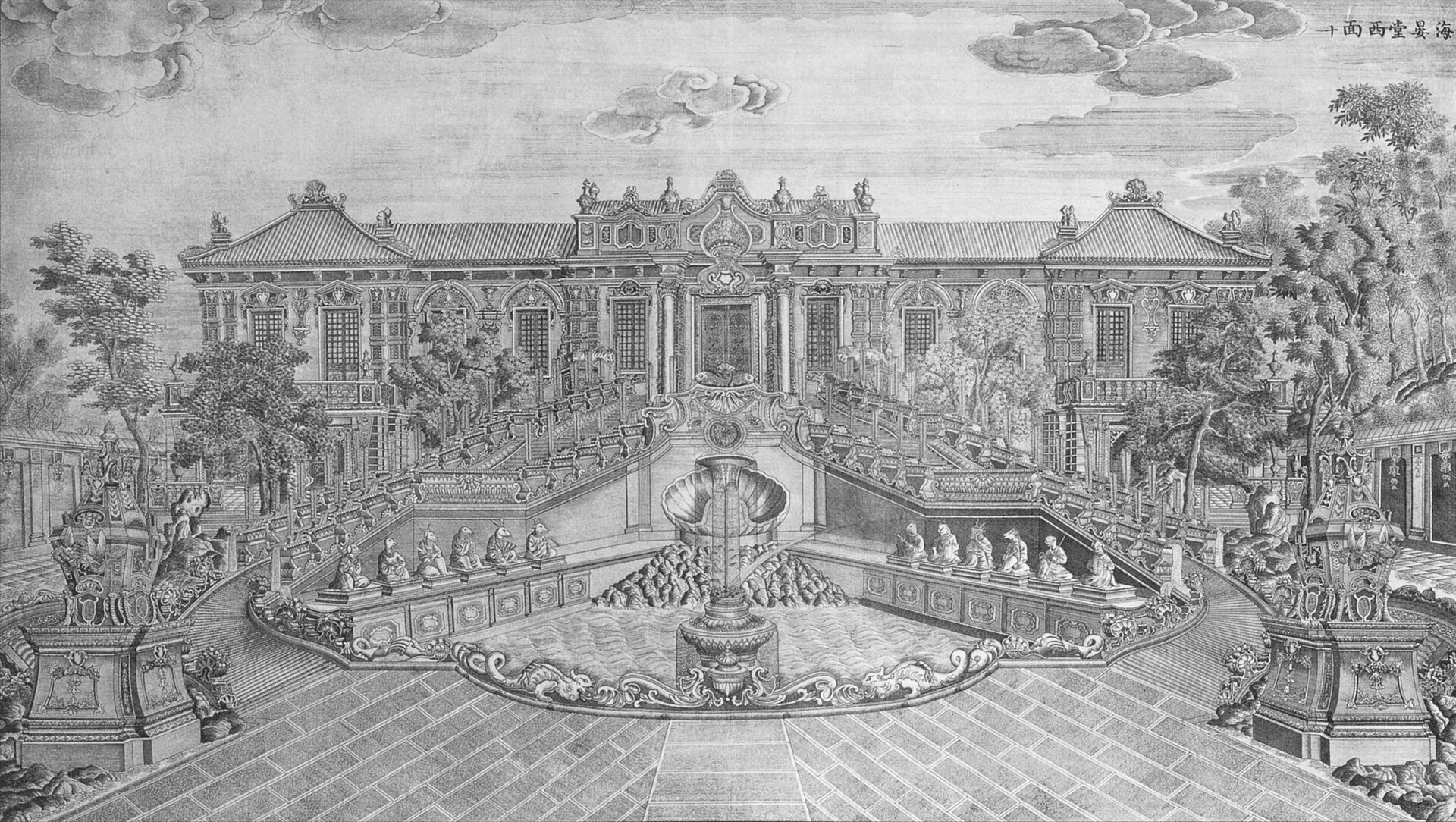
French missionaries still served at court under the Qianlong Emperor. When he built European-style palaces in the Yuanmingyuan — the Old Summer Palace — the Italian painter Giuseppe Castiglione designed the buildings and the French Jesuit Michel Benoist the great fountains. The French painter Jean-Denis Attiret had already, in 1743, written a long letter describing the Yuanmingyuan, which made the “Chinese garden” famous in Europe.
After his conquest of the Dzungars and the Muslim cities of the Tarim Basin, Qianlong ordered his court painters to depict the campaign in sixteen scenes, to be printed by European copperplate engraving. In 1765 the drawings were sent via Canton to Paris, where the engraving was supervised by Charles-Nicolas Cochin of the Royal Academy; it was not finished until 1774, when prints and plates were shipped back to Beijing. These Conquests of the Qianlong Emperor are a remarkable record of Franco-Chinese artistic exchange.
The Opium Wars and the unequal treaties
After the Revolution of 1789 direct contact between France and China lapsed for a time. After the First Opium War, the French envoy Théodore de Lagrené signed the Treaty of Whampoa with the Qing commissioner Qiying in 1844, winning trading rights similar to Britain’s and the right to build churches in the treaty ports. That year Qiying asked the throne to relax the ban on Christianity, and in 1846 the Daoguang Emperor ordered churches confiscated in earlier reigns to be returned. In 1849 France established its Concession in Shanghai, north of the walled city.
In 1856 the French missionary Auguste Chapdelaine was put to death by officials in Xilin county, Guangxi. Napoleon III used this as a pretext to join Britain in the Second Opium War. In October 1860 British and French troops entered Beijing; French soldiers were the first to plunder the Yuanmingyuan, and then the British envoy Lord Elgin ordered it burned, a fire that raged for two days. The Qing court signed separate Conventions of Peking with Britain and France. The Chinese text of the French convention contained an extra clause allowing missionaries to rent and buy land in the provinces — reportedly slipped in by the French interpreter — which later fed many anti-missionary disputes.
The plunder was shipped to France, where Empress Eugénie displayed it in a “Chinese Museum” at Fontainebleau. In 1861 the writer Victor Hugo, writing to a Captain Butler, condemned Britain and France as “two bandits” who had broken into the Summer Palace, and hoped that one day France would return the loot to China.
Afterwards
After the Second Empire, France continued to expand in Vietnam, and fought the Sino-French War with China in 1884–1885, after which Vietnam became a French protectorate; in 1898 France also leased Guangzhouwan. The French Concession in Shanghai lasted into the 1940s. Over three centuries France and China went from partners in learning and art to aggressor and victim, and both relationships left their mark — in the broken columns of the European palaces of the Yuanmingyuan, and in the Chinese Museum at Fontainebleau.