The prince of Angoulême
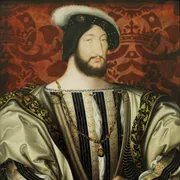
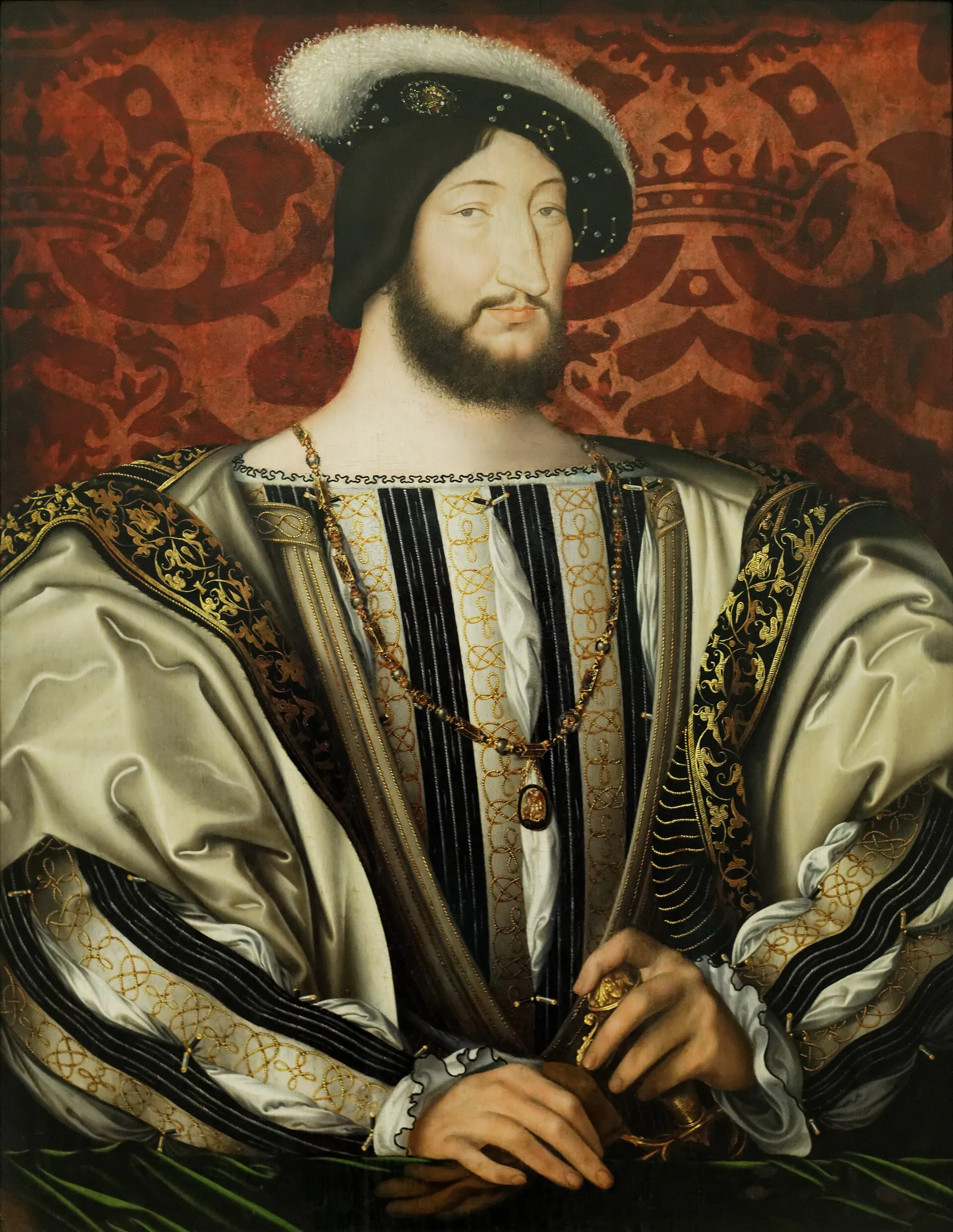
François was born at Cognac on 12 September 1494. His father, the Count of Angoulême, of a junior branch of the Valois, died when he was two. His ambitious mother, Louise of Savoy, pinned all her hopes on him, calling him “my lord, my king, my Caesar and my son”. His brilliant sister Marguerite, later Queen of Navarre and author of the story collection the Heptaméron, was his closest adviser all his life.
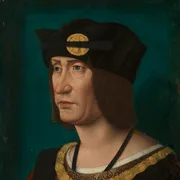
King Louis XII had only daughters, and since women could not inherit the French crown, his young cousin François became heir presumptive. In 1514 he married Louis’s elder daughter Claude; when Louis died on New Year’s Day 1515, François became king at twenty. Some six feet tall and passionate about hunting, jousting and dancing, he was the opposite of his ailing predecessor.
Victory at Marignano
Francis crossed the Alps at once to claim the duchy of Milan. In September 1515 at Marignano he fought for two days against the Swiss mercenaries, reputed the finest infantry in Europe, and won with his artillery and cavalry. Legend says he then asked the famous knight Bayard to dub him a knight. The next year his Concordat of Bologna with Pope Leo X gave him the right to appoint France’s bishops and abbots, putting the French Church firmly under royal control.
Rivalry with Charles V
When the Emperor Maximilian I died in 1519, Francis stood for election as emperor and spent fortunes bribing the electors, but lost to the young King Charles of Spain — Charles V. Charles ruled Spain, the Netherlands, Austria and southern Italy, encircling France, and the two rivals fought for nearly thirty years. In 1520 Francis met Henry VIII of England near Calais, where the two kings tried to outdo each other in splendid tents and display — the Field of the Cloth of Gold — but no alliance came of it.
On 24 February 1525 the French were routed at Pavia in Italy; Francis’s horse was shot under him and he was captured and taken to Madrid. He wrote to his mother that all was lost save honour and his life. The next year he signed the Treaty of Madrid, promising to give up Burgundy and handing over two of his sons as hostages for his release — one of them the future Henry II. Back in France, he declared the treaty void because it had been signed under duress.
To fight Charles V, Francis even allied with the Muslim Ottoman Empire of Suleiman the Magnificent, to the horror of Christian Europe. In 1530, under a peace treaty, he married Charles’s sister Eleanor of Austria, but relations did not improve, and war broke out again and again until his death.
A Renaissance king
The Italian Wars were ruinous, but they opened French eyes to the brilliance of the Italian Renaissance. In 1516 Francis invited the aged Leonardo da Vinci to France, housed him at Clos Lucé near Amboise and named him “first painter, architect and engineer to the king”. The Mona Lisa, which Leonardo brought with him, has remained in France ever since and hangs today in the Louvre. The story that Leonardo died in the king’s arms is probably a legend.
In 1519 Francis began building Chambord on the Loire, whose central double-spiral staircase may owe something to Leonardo. He greatly enlarged Fontainebleau, bringing in the Italian painters Rosso Fiorentino and Primaticcio to decorate its galleries and giving rise to the “School of Fontainebleau”; the goldsmith Benvenuto Cellini made him a famous salt cellar. In 1530 he appointed “royal lecturers” to teach Greek, Hebrew and mathematics free of control by the theologians of the University of Paris — the origin of today’s Collège de France. In 1537 he required a copy of every book printed in France to be deposited in the royal library, founding legal deposit, and his Ordinance of Villers-Cotterêts of 1539 required laws and official documents to be written in French rather than Latin.
The New World and religion
Francis also looked overseas. In 1517 he ordered the building of the port of Le Havre, and from 1534 he sponsored three voyages across the Atlantic by the Breton navigator Jacques Cartier, who explored the St Lawrence; the name “Canada” spread from Cartier’s accounts. “Show me the clause in Adam’s will,” Francis is said to have quipped, “that divides the world between Spain and Portugal.”
In religion he was at first tolerant of humanists and reformers, and his sister Marguerite protected many evangelical thinkers. But in October 1534 posters attacking the Catholic Mass appeared in Paris and even on the door of the king’s bedchamber at Amboise — the Affair of the Placards. Seeing it as a challenge to his authority, Francis ordered a harsh crackdown on Protestants, and the young John Calvin fled to Switzerland. In 1545 Waldensian villagers in Provence were massacred. The persecution did not stop Protestantism spreading; it only deepened religious division.
Last years
In 1536 the Dauphin François died suddenly, leaving the second son, Henry, as heir. Plagued by illness in his last years, the king died at Rambouillet on 31 March 1547, aged fifty-two, and was succeeded by Henry II. In thirty-two years on the throne he left Chambord, Fontainebleau and a great art collection — and also heavy debts and an unresolved religious conflict.