A peasant girl from Domrémy
Joan was born around 1412 in the village of Domrémy on France’s north-eastern border. Her father, Jacques d’Arc, was a prosperous farmer, and her mother, Isabelle Romée, was deeply devout. Joan could not read; she spun wool and minded the animals at home. The Hundred Years’ War was at its darkest: Charles VI was mad, the princes had split into Armagnacs and Burgundians, and after his victory at Agincourt Henry V of England had been made heir to France by the Treaty of Troyes. Domrémy was loyal to the Dauphin Charles, but Burgundian soldiers often raided the area.
At her trial Joan said that at about thirteen she first heard a voice, accompanied by light, in her father’s garden. She believed it came from the Archangel Michael and from Saints Catherine and Margaret. At first they simply urged her to be good and pious; later they told her to leave home, drive out the English and bring the Dauphin to Reims to be crowned.
The road to Chinon
In 1428 the English besieged Orléans on the Loire, the Dauphin’s last great stronghold in the north. Joan went to nearby Vaucouleurs and asked its captain, Robert de Baudricourt, to send her to the Dauphin; twice he refused. Early the next year she is said to have foretold a French defeat near Orléans, and Baudricourt gave way. In February 1429 seventeen-year-old Joan cut her hair, put on men’s clothes and, escorted by six men, crossed enemy territory in eleven days to reach the castle of Chinon.
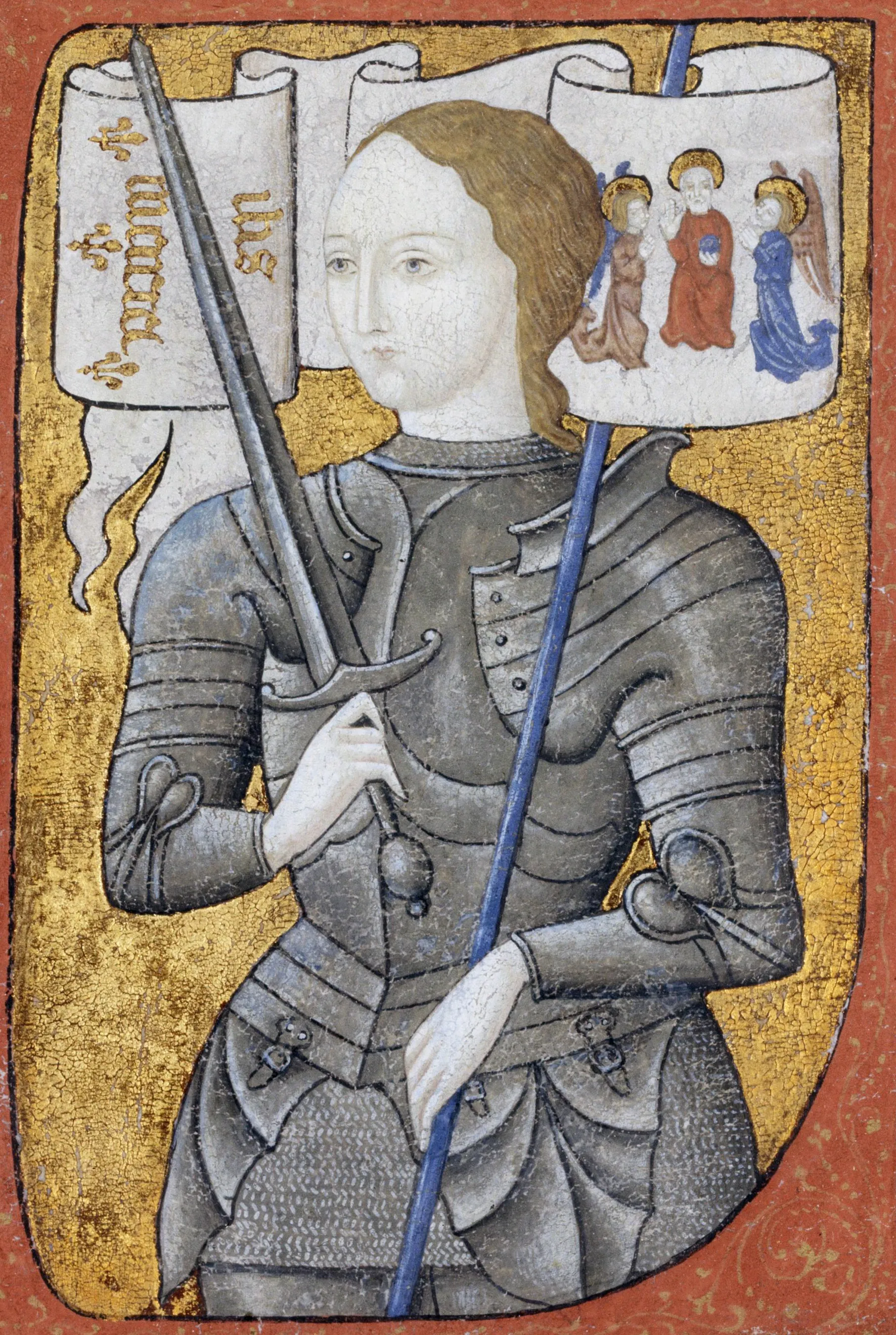
Legend says the Dauphin hid among his courtiers to test her, and that she picked him out at once. What they said in private remains a mystery. Still uncertain, the Dauphin had theologians question her for weeks at Poitiers; finding nothing against the faith in her, they advised that she might be tried. He gave her a suit of armour and a banner bearing the figures of Christ and angels, and sent her with a relief force to Orléans.
The Maid of Orléans
Joan entered Orléans on 29 April 1429 to an ecstatic welcome. She knew nothing of tactics, but her fierce conviction lifted the soldiers’ spirits, and she sallied out with commanders such as the Bastard of Orléans, Jean de Dunois. On 7 May, in the attack on the English fort of Les Tourelles, an arrow struck her in the shoulder; she pulled it out, had the wound dressed and returned to the fight, and the fort fell. The next day the English withdrew. The siege was lifted nine days after her arrival, and she became known as the Maid of Orléans.
The French pursued their advantage along the Loire and crushed the English at Patay in June. Joan pressed for an immediate march to Reims; the army crossed enemy-held country, and town after town opened its gates. On 17 July the Dauphin was crowned Charles VII in Reims cathedral, with Joan standing near the altar holding her banner. Asked later why she had brought it into the church, she replied: “It had been through the hardship; it was right that it should share the honour.”
Setbacks and capture
After the coronation Charles VII inclined towards negotiating with the Duke of Burgundy, while Joan wanted to fight on. In September 1429 she led an attack on Paris, was wounded in the leg, and the king ordered a retreat. The following May she went to help Compiègne, besieged by the Burgundians. During a sortie she was caught at the rear when the town gate was closed, pulled from her horse by Burgundian soldiers, and taken prisoner.
Her captor, John of Luxembourg, a vassal of the Duke of Burgundy, sold her to the English for 10,000 livres. The English were eager to prove her a witch or a heretic, which would cast doubt on the legitimacy of Charles VII’s coronation. Charles made no attempt to rescue her. While held at Beaurevoir, Joan leapt from a tower in an attempt to escape, but was injured and recaptured.
The trial at Rouen
In January 1431 the English convened a church court at Rouen, which they held, under Pierre Cauchon, the pro-English Bishop of Beauvais. For months dozens of theologians questioned the unlettered young woman, trying to trap her into incriminating herself. Asked whether she knew she was in God’s grace — to say yes would be presumptuous, to say no an admission of guilt — Joan answered: “If I am not, may God put me there; and if I am, may God so keep me.” Her questioners had no reply.
On 24 May, faced with the stake, Joan put her mark to a recantation; her sentence was commuted to life imprisonment and she agreed to wear women’s clothes. A few days later she put on men’s clothes again, saying the saints had reproached her for betraying her mission. The court condemned her as a relapsed heretic. On 30 May 1431 she was burned in the Place du Vieux-Marché at Rouen, asking a friar to hold up a cross before her and calling on the name of Jesus to the end. The English threw her ashes into the Seine.
Rehabilitation and sainthood
Charles VII recovered Rouen in 1449 and the next year ordered an inquiry into the trial records. At the request of Joan’s mother, the pope authorised a retrial, and in 1456 the court declared the original verdict null and void, restoring her good name.
Over the following centuries Joan became a symbol of France, claimed by every political camp: Napoleon revived the celebrations in her honour at Orléans in 1803, and nineteenth-century historians made her the embodiment of popular patriotism. She was beatified in 1909, canonised in 1920, and two years later declared a secondary patron saint of France. Every May, Orléans still holds a festival to commemorate the raising of the siege.